Real client advice, with identifying names replaced
The complete client LOI memoranda and selected LOI examples come from actual engagements involving real companies. Company, counterparty and personal names have been replaced. Figures, estimates and illustrative scenarios are retained as labeled in each document. The memos show transaction-specific judgments and proposed terms, rather than completed results.
The separate ABC Co. packet is an illustrative engagement with fictional names and figures. Generic company names do not mean all examples concern the same engagement.
REAL ENGAGEMENT · SANITIZED EXCERPTS · ACTUAL LOI WORK
Seller education and retained equity
Explain the economics and ownership rights behind an offer.
Seller education and retained equity2 pages
Read at page width. Scroll down for page controls.
Read page 1 as text
Selected real engagement work | Adapted for website review
1
SYNERGY BUSINESS BROKERS
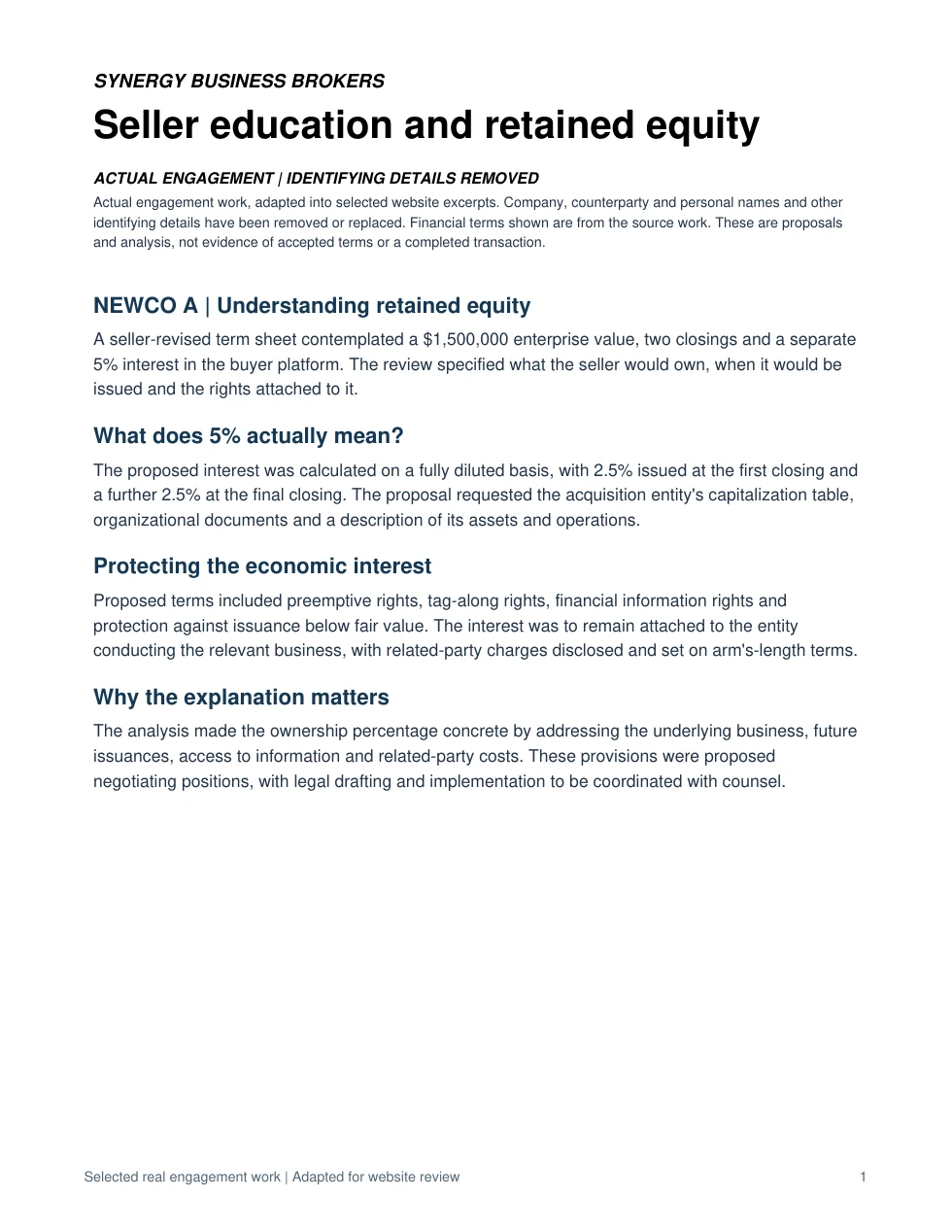
Seller education and retained equity
ACTUAL ENGAGEMENT | IDENTIFYING DETAILS REMOVED
Actual engagement work, adapted into selected website excerpts. Company, counterparty and personal names and other
identifying details have been removed or replaced. Financial terms shown are from the source work. These are proposals
and analysis, not evidence of accepted terms or a completed transaction.
NEWCO A | Understanding retained equity
A seller-revised term sheet contemplated a $1,500,000 enterprise value, two closings and a separate
5% interest in the buyer platform. The review specified what the seller would own, when it would be
issued and the rights attached to it.
What does 5% actually mean?
The proposed interest was calculated on a fully diluted basis, with 2.5% issued at the first closing and
a further 2.5% at the final closing. The proposal requested the acquisition entity's capitalization table,
organizational documents and a description of its assets and operations.
Protecting the economic interest
Proposed terms included preemptive rights, tag-along rights, financial information rights and
protection against issuance below fair value. The interest was to remain attached to the entity
conducting the relevant business, with related-party charges disclosed and set on arm's-length terms.
Why the explanation matters
The analysis made the ownership percentage concrete by addressing the underlying business, future
issuances, access to information and related-party costs. These provisions were proposed
negotiating positions, with legal drafting and implementation to be coordinated with counsel.